
How Warm Should Your Bed Be? A Straightforward Guide for Hot Sleepers, Cold Sleepers and Couples
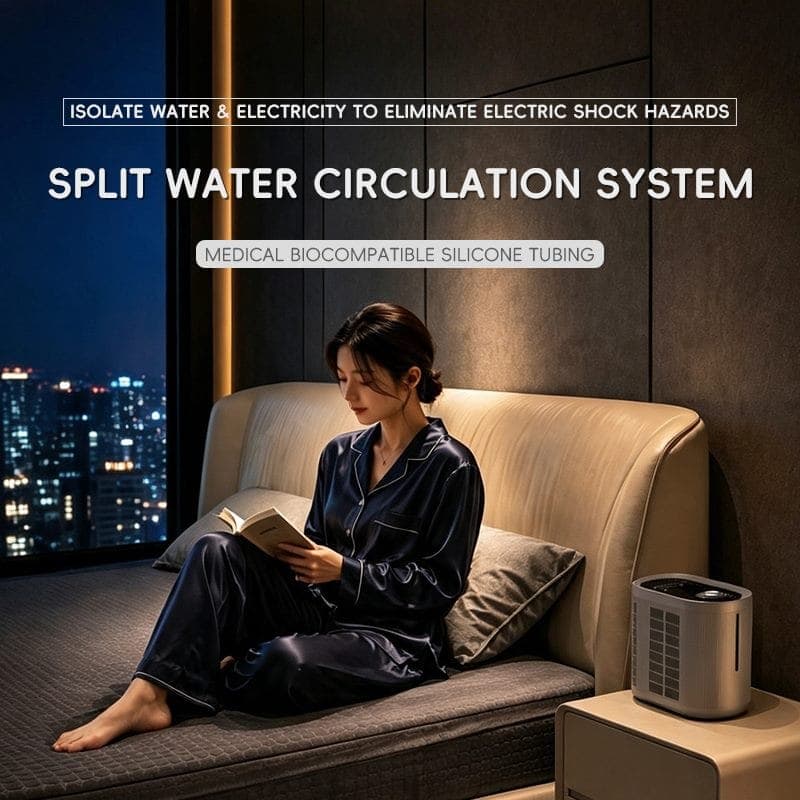
Here is a question with no single answer: how warm should your bed be? Your partner's perfect bed feels like a furnace to you. Your friend swears by a cool pad; your mother keeps her bedroom like a sauna. All of them are right — for themselves.
The honest answer is that "warm" is personal, but the range is not magic. Understanding a few numbers will save you a lot of trial and error.
The numbers that actually matter
Sleep researchers tend to talk about three temperatures, and they are easy to mix up:
- Room temperature. The most commonly cited comfortable range for sleep is 15–19°C. Cooler rooms help the body drop its core temperature at bedtime.
- Bed surface temperature. This is what you actually feel against your skin. Most people find a surface around 28–33°C comfortable to lie on; below that feels cold, above feels sweaty.
- Your own body. Women tend to run a slightly higher core temperature but colder hands and feet; men often run warmer overall. It is not in your head — it has been measured in office studies such as the 2015 Nature Climate Change analysis of indoor thermal comfort.
If you are a hot sleeper
You know who you are: duvet kicked off by 1am, pillow flipped twice, cold shower before bed "helps". Night sweats — common around menopause, after exercise, or from certain medications — make the problem worse.
Start the pad around 18–20°C for the first hour. That pre-cooling window is when your body is trying to drop its core temperature, so a cool surface is doing exactly what your physiology wants. Once you are asleep, a gradual rise to around 22–24°C keeps you comfortable without the shiver-and-sweat cycle.
One practical trick: cool the bed before you get in, not after. Lying on a surface that is already cool shortens the time it takes to fall asleep measurably.
If you are a cold sleeper
Cold sleepers are usually cold in the extremities, not the core. Cranking the whole bed to maximum feels lovely for ten minutes and then becomes a sweat-fest at 3am as your body tries to shed the excess.
A better setup: warm the bed to around 32–36°C for the 30 minutes before you get in, then let it settle a few degrees lower for the night. If your feet are the problem — they usually are — point more warmth toward the foot zone rather than the whole surface.
One warning: don't use a high setting all night. Your body still needs to cool slightly to maintain deep sleep, even in winter.
If you share a bed (the classic fight)
The thermostat wars are real, and the data says the disagreement is genuine, not stubbornness. Research in the 2015 Nature Climate Change paper found women prefer an ambient temperature roughly 2–3°C warmer than men in the same room. That gap is nearly impossible to bridge with one shared setting.
This is exactly the problem a dual-zone pad solves: each side controls its own temperature independently. Set one side at 20°C and the other at 33°C and both of you get what you want, on the same bed, without a compromise either of you resents.
If you are buying one system for two people, make sure it has independent left/right control — a single-temperature pad just moves the argument down to the bed.
Quick-start settings
- Hot sleeper / night sweats: start 18–20°C, raise to 22–24°C after sleep onset.
- Cold sleeper: pre-warm at 32–36°C, settle at 28–30°C for the night.
- Couples: set each side independently, typically 4–6°C apart.
- Change of season: adjust by 1–2°C per week rather than making one big jump.
- Warm weather: use the pad to cool, not the air conditioner — it uses far less power and doesn't dry the air.
The takeaway
There is no "right" bed temperature, only the right temperature for you. But the range is narrower than you think, and the equipment you choose — steady water circulation versus cycling electric heat — changes how reliably you can stay in it.
Find your number, set it once, and let the bed hold it. That is the whole trick.
Where to go from here
If you have been woken up by heat or cold for too long, start with how water-circulation temperature control works — simpler than it sounds, cheaper than you think.